Free Trade
The state rulers have always tried to control trade in order to
- distribute privileges to selected groups of people in order to gain their support (concession of trade monopolies)
- obtain some revenue by taxing import goods.
For these reasons, free trade as advocated by liberals in the XVIII century was fully disruptive of practices proper to the Ancien Régime. As heirs of the liberal conception in its most advanced form, both socialists (Marx) and anarchists (Kropotkin) have been in favour of free trade.
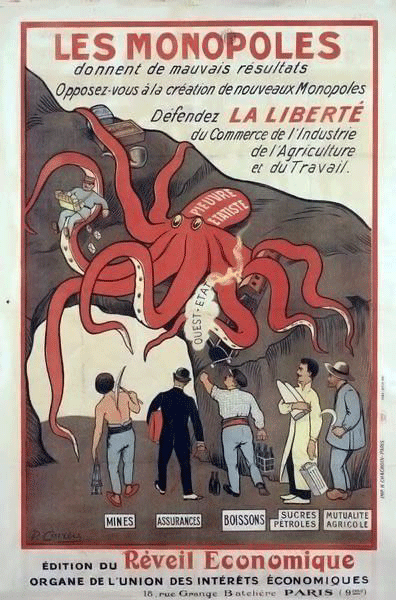
The position on trade of classic anarchists
Piotr Kropotkin was in favour of world commerce and decentralisation of industry.
"The present tendency of economical development in the world is ... to induce more and more every nation, or rather every region, taken in its geographical sense, to rely chiefly upon a home production of all the chief necessaries of life. Not to reduce, I mean, the world-exchange: it may still grow in bulk; but to limit it to the exchange of what really must be exchanged, and, at the same time, immensely to increase the exchange of novelties, produce of local or national art, new discoveries and inventions, knowledge and ideas." Fields, Factories and Workshops Tomorrow, 1899
Free trade or fair trade?
The opposition between free trade and fair trade is a fake opposition. This opposition has re-emerged recently through the writings and actions of the anti-globalization movement (in which certain anarchists have played a large part).
The concept of fair trade is not a new one and its origins do not bode well for the people in the countries the anti-globalizers want to support. In 1881, some politicians and businessmen set up in England the "Fair Trade League" that advocated the putting up of tariffs to protect British industries against competition from the emerging industrial powerhouses of Germany and the United States. One of the most vociferous exponents of the League was Joseph Chamberlain, the champion of the nationalistic and imperialistic policies carried out by the English state at the end of the 19th century. He was in favour of a system of protective and preferential tariffs to guard the empire against goods originating from other countries, a policy in total opposition to the previous one of the open door.
It is then appropriate to say that: Fair trade is the slogan used by the owners and shareholders of big backward companies in order to protect their interests. Free trade is a practical tool that is in the interest of the people of emerging regions that are now kept outside the flow of world trade (for instance by Fortress Europe). When anarchists are against free trade they are just supporting the economic and political interests of the strongest (state protected) sectors of society.

State capitalism as protectionism
In the course of their history the United States, considered by many the capitalist country par excellence, have been and still are one of the most protectionist states in history. The United States government has been highly protectionist since the end of the civil war (1865) and then later (1890) with the ultra-protectionist McKinley tariff act. As a matter of fact, the decade that saw the big crash started with the protectionist tariffs of the Fordney bill (1922) and ended with a further increase sanctioned by the Hawley-Smoott tariff act (1930).
Free society = free exchanges
The historian Fernand Braudel has identified society with exchanges. So, a free society requires free exchanges in every aspect of life (material, cultural). The freedom to decide what to exchange and with whom to exchange makes free exchange equivalent to fair exchange.
“All modern, industrialized societies rely on markets for the exchange of ideas, goods, and services. The free market, with its voluntary exchange of ideas, goods, and services, is the only one that fits the anarchist model of a society based on voluntary cooperation and free association of individuals and groups. While the free market is often associated with free market capitalism, it does not really endorse any economic system. The free market really is about the voluntary exchange of products, by whatever means the individuals agree on. For those still unconvinced about the value of a free market in implementing anarchism, the other option is an involuntary or forced exchange of ideas, goods, and services, which is the method of the state.” http://www.strike-the-root.com/4/weebies/weebies4.html